The Office of the Measured Return
5 October 2026 · v0.2.2 candidate. An original Iron Litany mechanism, not a canonical Warhammer rite. See rites and mechanical speech for its broader design.
Work the pressure, then witness the answer
At the Cooling Reliquary, measured relief becomes available with a trapped head of 62 or above. Preparation spends one oil and takes 0.8 seconds to isolate the return. The watch continues: an isolated return impedes cooling, and existing faults, heat, movement and enemy fire still matter.
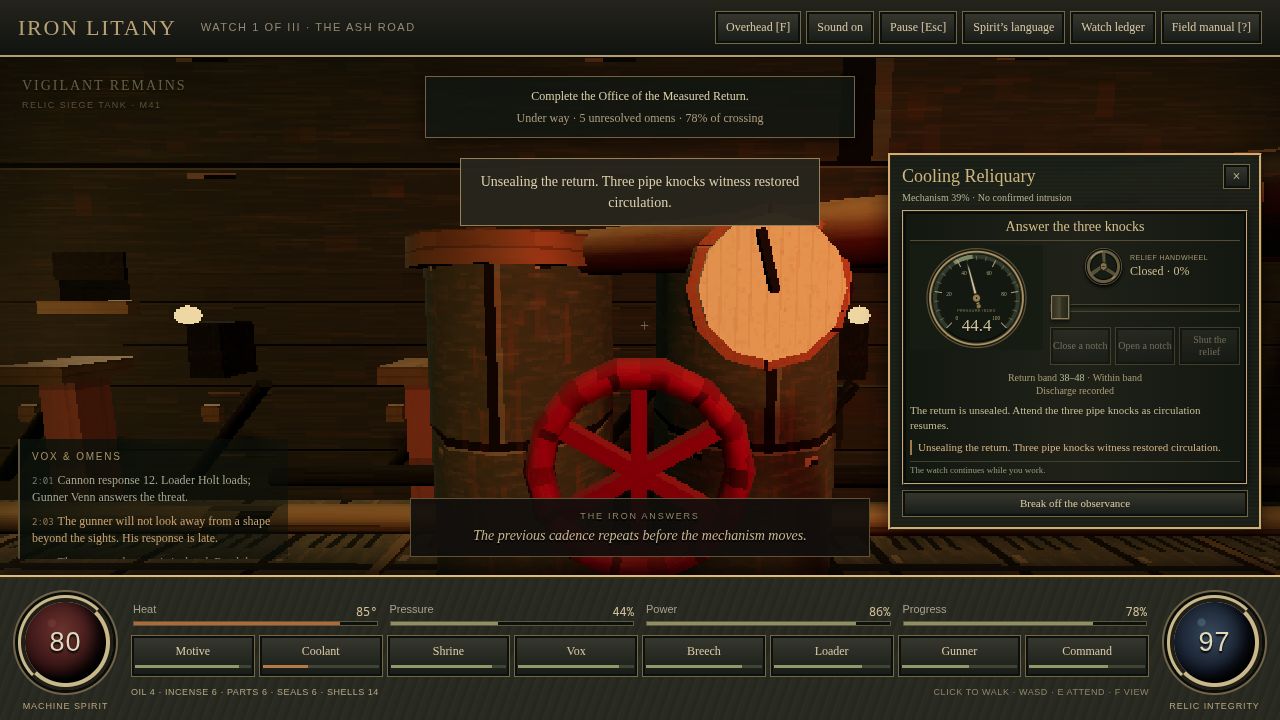
Set the handwheel opening against the live gauge. Its setting remains where you leave it; releasing the slider does not shut the valve. Crack the relief, reduce the opening near the 38–48 return band, then seal it. A valid witness requires actual discharge and 1.2 seconds with the relief closed inside the band. Explicitly unseal the return and attend its three pipe knocks over 1.4 seconds. Only that completed response restores accord and clears the coolant circuit's physical faults.
Overbleeding admits air and wears the real sealing faces, up to 15 health points per prepared rite. Shut the relief, allow the live pump to recover, and establish the witness again. Completion preserves the recorded wear. It cannot purify an independent Chaos vector. Walking away, closing the station or breaking off consumes the prepared oil and grants no completed response.
The slider, ten-percent notch buttons and explicit Shut control give deliberate alternatives to dragging. Native slider keys work; numeric readings, band status and captions support play with sound off. Pause freezes the plant. Reload retains the paid rite and valve opening, reopens the coolant panel and waits for explicit Resume. Vent sound follows opening and head; closing, cancellation, pause and mute stop it. Return knocks follow simulation time and do not replay elapsed beats after reload.
Choose the service the vessel needs
| Coolant service | Time and material result | Useful when |
| Ordinary condition-led observance | 4.4 seconds of acts, plus decisions; fixed 22-point pressure relief, +36 mechanism health and −23 heat, with stronger accord restoration | Routine wear or a manageable head needs broad maintenance |
| Measured return | Isolation, controlled bleeding, closed witness and explicit return; pressure reaches the actual band; +28 mechanism health, limited by recorded wear, −18 heat and +6 spirit | A severe head needs deeper pressure relief and the priest can attend the gauge |
Both spend one oil. Measured relief is not a universal speed upgrade: severe pressure takes longer to regulate than the ordinary observance, and careless work can damage the seal. The older complete by-book coolant rite remains compatible with saves and takes seven seconds of ordered acts. Planning the cause, opening and stopping point matters more than matching an arbitrary rhythm.
Actual first-crossing QA: error and recovery
These are the root agent's recorded seed-41 interface observations, including planning pauses and tool-latency delays. This was a recovered mistake, not a clean or perfect measured rite. Times are simulation seconds; readings marked approximate were reported approximately.
| Observed action | Recorded result |
| Prepared measured relief at 118.55 | Pressure approximately 68.6; oil 5 → 4 |
| Tried sealing above the band | Unsafe closure was rejected as a witness; the valve closed physically |
| Set a partial opening and paused at 130.85 | 30% retained opening, pressure 74.3056187, cumulative discharge 2.6489153 |
| Reloaded the saved watch | The same pressure, discharge and opening returned exactly; coolant panel reopened paused |
| Resumed and used keyboard End | Opening reached 100%; observed pressure 71.084, discharge 6.34943 |
| Inspected runtime sound routing | Relief active; observed gain 0.0946, playback rate 1.145, two live sources. This is routing evidence, not listening approval |
| Left the relief fully open too long during tooling | Pressure fell to approximately 5.2; recorded seal wear reached its 15-point bound |
| Used Shut and recovered | Live pump pressure recovered; sealing in band then established the full 1.2-second witness |
| Began the return at approximately 148.85 | Pressure approximately 43.4; explicit return response began |
| Completed at 150.25 | Spirit acknowledgements 1 → 2; coolant mechanical and recoil faults resolved; independent vox Chaos and other problems remained |
| Read the vessel at 154.8 | Pressure 51.59, heat 80.75, hull 91.69, coolant health 37%, oil 4 |
| Continued triage | One part repaired the seal; vox inspection and targeted purge followed. Repair halt 1 was reached at 177.9, all three crew were replaced, and the actual watch entered Crossing 2 |
The 37% coolant reading includes continuing fault wear, delay and overbleed; it does not isolate the overbleed penalty alone. Pressure rising after a correct return is expected live behavior, not a second completion or failed witness. The saved opening, bounded cost, recovery, physical-only resolution and single acknowledgement were demonstrated through this run. A fresh controlled replay is recorded below.
The first integrated test run reported 63 passing cases; a subsequent inspection-clearance test brings the final candidate to 64. Automated checks cover pressure regulation, invalid starts, unsafe sealing, bounded wear, cancellation, pause, save stages, manufactured early success and supported simulation steps. They supplement the interface evidence rather than certify art, listening or final difficulty.
Fresh regulated replay
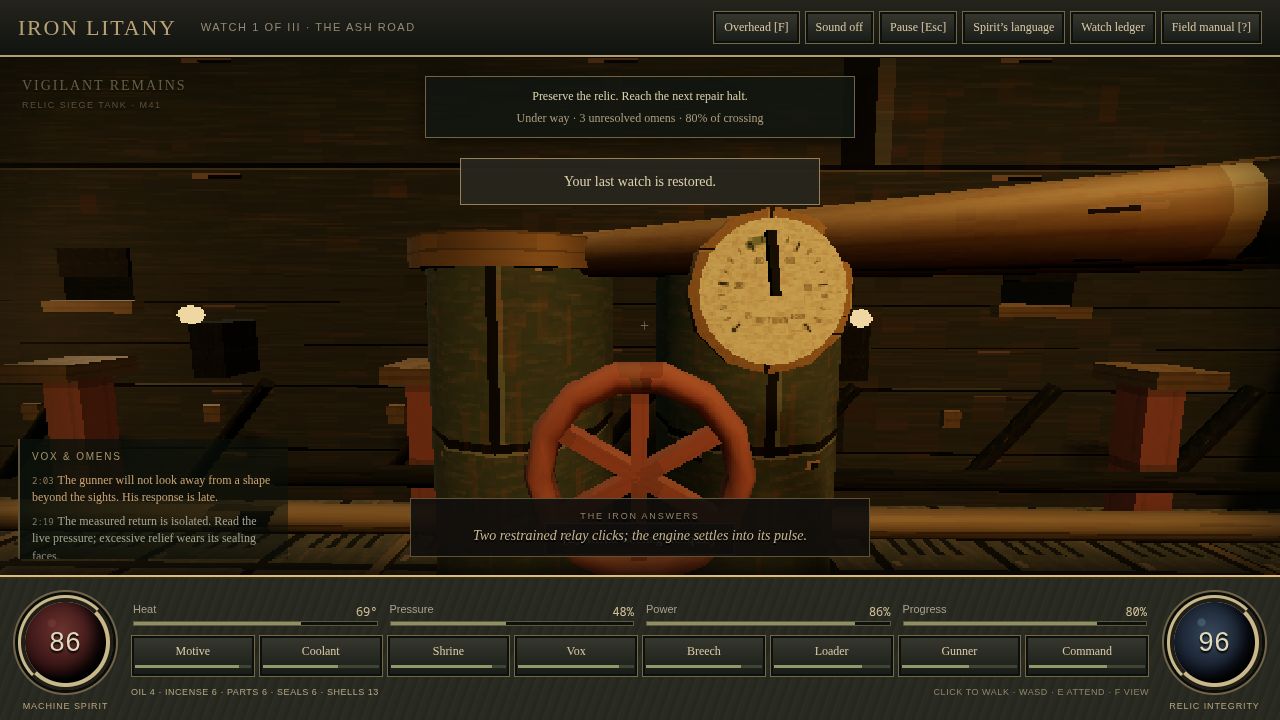
A fresh seed-41 interface run corrected the loader and reached the coolant station. At time 139.70 the real head was 78.2255. Preparation spent one oil (5 → 4). Normal keyboard inputs opened fully, then reduced to 30% near the band. At 145.30 the head was 41.4533 and recorded wear was zero. Sealing and holding the closed witness enabled the explicit return at 146.75; the 146.90 frame records 44.3717 pressure, 1.2 seconds of stable witness, zero opening and zero wear. Completion by 148.35 left 47.0369 pressure, approximately 65% coolant health and one additional acknowledgement (1 → 2). Both coolant physical faults cleared. Read-only state frames are in the replay record, with an actual first-person return frame. No state or time was injected.
A separate second-crossing observation was lost at 300.55 to neglected augmetic intrusion. Its correctly sealed witness had expired while inspection paused at the tooling boundary without pausing the game; pressure left the band and returned to regulation, granting no completion. The loss had hull 77 and spirit 55. This is a genuine failure with unrelated duties neglected, not a successful campaign or final balance approval. The earlier v0.2.1 complete campaign remains separate evidence.
At 1280×720, actual first-person play confirmed the compact panel shows the gauge, opening, adjustment/shut controls, instruction and seal without scrolling in its ordinary vent state. Long wear/witness text may require a short scroll with the dial kept visible. Narrow/touch layout is implemented but has not had a new touch-device playthrough.
Remaining acceptance
Runtime art and the Diablo I material target remain in review. The priest does not yet place a visibly gripping hand on the handwheel, and tactile resistance is not represented. Metered coolant volume is also future work; current overbleed uses actual seal health rather than an invented supply meter. Gunner sight contact, commander driving contact and final crew motion still need demonstrated improvement in both cameras. Human listening and sustained mix acceptance remain open. No cinematic or narrated gameplay approval is implied.
The marked world gauge and worn iron handwheel received a final material refinement after the return capture. Actual final physical gauge records the live post-service head, with no browser error or warning observed after reload. The return capture preserves the earlier visible dial treatment rather than misrepresenting it as that final refinement.