Keep the work readable under attack — v0.5.1
This is a bounded interface and feedback revision, using the existing original art, mechanical sound vocabulary and 31 priest clips. It does not approve character art, listening quality or the complete campaign. No new local model, audio-generation batch or native build was started.
Findings through actual input
An isolated local watch completed the moving engine lesson through the lever and cup. It then followed a reported wound, drew the blade, encountered the embedded browser's capture refusal, selected the explicit drag fallback and made a real cut. That cut killed two nearby small bodies while all six pistol rounds remained unspent. The sources stayed open; that run does not claim successful binding or a campaign victory.
The baseline had two directly visible problems:
- Drag aiming was selected, but the immediate threat card instructed “Move the mouse to aim.” The lower control hint correctly named right drag, so the two displays disagreed.
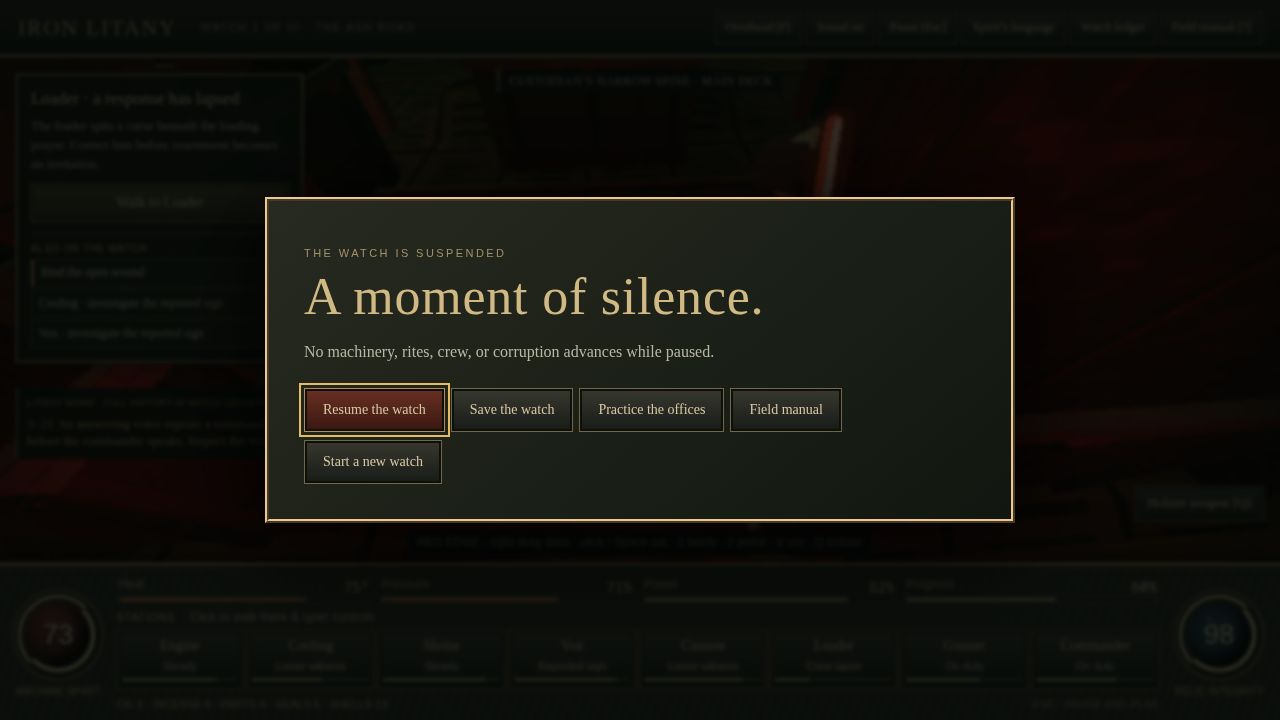
- At 1280 × 720, the combat readout occupied
(445, 385.22, 390, 95.59)while the priest caption occupied(400, 432.22, 480, 41.59). Their rectangles overlapped by approximately 41.6 vertical pixels. The caption covered weapon information and part of the selection controls. Baseline screenshot records the actual saved review watch.
A separate code review found that an interrupted office could receive completion speech if an unrelated good log message occurred at the same time. Completion must belong to the actual office, not merely be a positive report.
After the aiming-message correction, the restored review watch displayed the right-drag instruction during a real encounter. While other tool work continued, that watch was left unattended and reached ward defeat. This was not a campaign victory or a controlled balance experiment. Subsequent layout review used the separate protected practice watch, which preserves the saved campaign and avoids treating tool latency as player response time.
Changes
Armed combat information occupies a small brass-framed upper-right panel in both captured and drag aiming. Priest captions stay in their own lower band. No scene material, camera, sampling, corpse pool or character mesh changed.
The threat card reads the selected weapon and actual aiming mode. It names right drag for the fallback, free mouse movement only after capture, and the grip request while capture is still needed. Blade advice distinguishes a nearby body from one beyond its actual reach, using the same reach constant as the strike. An empty or charging pistol names the immediate V cut rather than instructing an unavailable shot. The weapon readout distinguishes ready, returning, charging and empty states with words and a restrained ivory/amber/red witness.
Drawing the blade or pistol captions its existing original spoken line. A fresh danger warning keeps priority over that caption; a stale work instruction yields to the draw line. This adds readable dialogue without generating or replacing any audio.
Completed offices append an explicit station-and-kind witness to the log. Speech considers only fresh witnesses since its previous observation and matches the departed office. Cancellation, an unrelated crew success, a different completed circuit and old success at the same timestamp cannot certify the abandoned work. Historic logs remain valid; the optional new completion record is bounded and checked on save. Restoring a watch does not replay old completion speech.
Objective checks
177 tests pass after this revision. Added checks cover actual aiming advice, blade reach and the nearest unobstructed body, melee advice during empty/charging pistol states, draw-caption priority, cancellation beside unrelated success, actual recoil-witness completion, no replay after restoration, and compatibility/validation of completion records. Earlier field-defence and save tests still apply. Native/publication evidence is recorded separately before release acceptance.
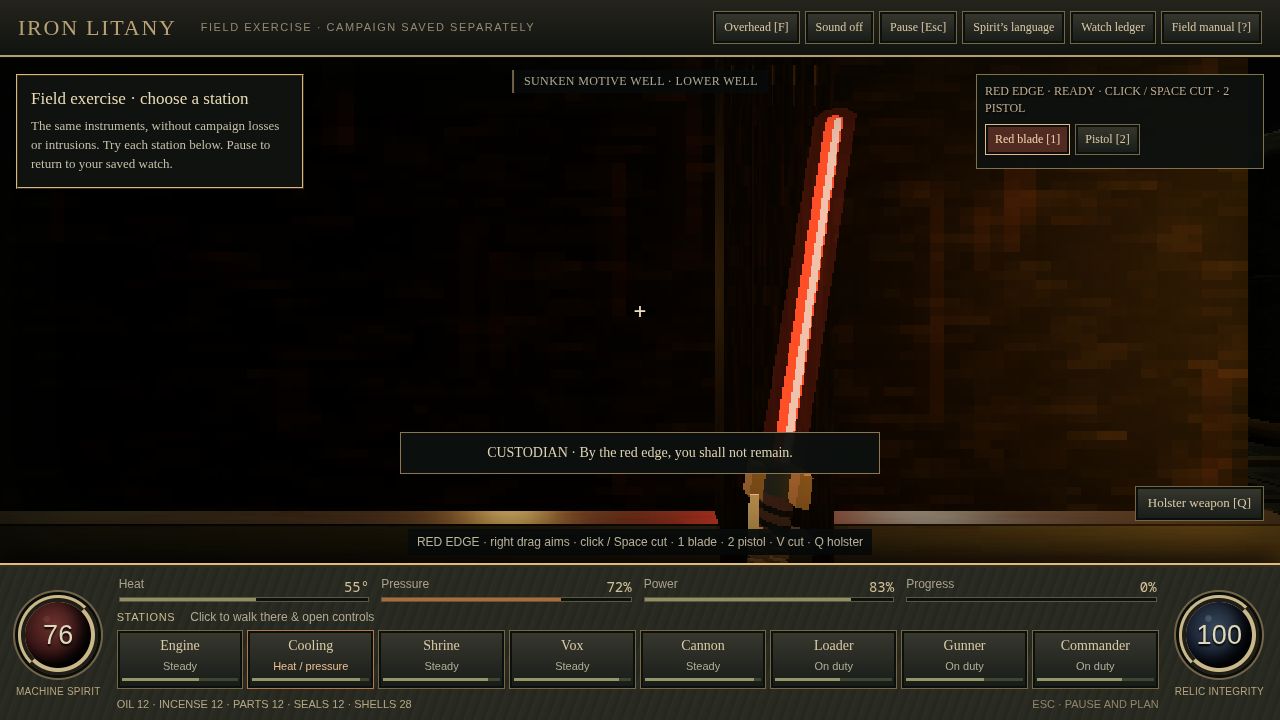
Actual Q and the explicit drag fallback in the practice watch show the armed readout at (976, 74, 288, 95.19) and the matching priest caption at (400, 432.22, 480, 41.59) in a 1280 × 720 viewport, with no intersection. Revised practice frame and desktop rectangle receipt record this result. This frame demonstrates layout, not a live attack or listening acceptance.
At 390 × 844, the armed readout, objective and priest caption remain visible without intersecting, and the document width remains 390 pixels. Narrow rectangle receipt records the bounds. This is responsive-layout verification, not touch-control or mobile-performance approval.
Final Diablo I-quality anatomy/materials, a complete human three-watch journey and sustained human listening remain open. Cinematic and narrated gameplay production still follows the creator's demo approval.