Crew, cannon and real contact
Version 0.3.1 candidate · 6 October 2026. This record describes original runtime geometry and actual local-browser input testing, not final Diablo I art approval.
The changes that matter in play
The commander now holds two fitted driving tillers. The gunner holds the handles of a traverse wheel attached to the moving turret and faces its sight. Their independent fixed-length arms solve to those actual world-space anchors; the anchors remain attached after static material batching. Quarantined operators disappear from duty as before. None of this motion grants a shot, ammunition, progress or a religious response.
The gun receiver now has cast cheeks, top/bottom structures, a hollow chamber, a dark interior and a reinforced mouth. Its loading gate exposes that cavity. A pointed steel nose, brass case and base collar replace the featureless round. During alignment the round turns toward the traversed bore. During insertion its hands follow the round and shift toward the tail while the loader steps forward. The tail clears the mouth before the hands release and the gate falls. Both the body and carry height read the actual staggered deck; the former additional worker offset no longer makes him float or sink.
Two shielded, restrained task lamps reveal the loading gallery and driving controls. Global lights, tone mapping, sampling, aperture admission and compartment exposure are preserved. Adult crew retain their previous substantial proportions and fitted workwear. Small original forehead creases and the commander's grey moustache distinguish the veteran face. These are limited refinements, not a finished authored character set. The priest retains revision 5.
Selecting the breech now walks to its aft-side opening and aims at the mouth, instead of planting the player beside and aiming at the solid side casing. Selecting the loader frames his actual current work position. The same physical body and deck remain authoritative in both cameras.
Actual input evidence
All captures use the real 1280 × 720 browser display and its ordinary 720 × 291 gameplay framebuffer. No injected state, hidden commands or teleportation completed the journey. Read-only diagnostics supplied the measurements. The local testing origin is separate from the creator's hosted watch.
- The first motive lesson completed through its three sustained tool contacts. The priest walked from the sunken well to the loading gallery.
- Five loading stages were captured during actual automatic cannon responses: acquire, lift, align, seat and clear. The bounded stage record reports zero overreach for commander, gunner and loader in every captured sample. Repeatedly selecting the loader deliberately reframed those samples; this is not a continuous fixed-camera film.
- The loader's mutinous lapse was corrected at 1:11. A first small body fell to two aimed pistol shots. While the priest attended the rattling coolant recoil witness and returned to its seam, another body appeared through the neglected wound; a second small intruder arrived from the dogleg. Four further aimed shots killed both. Holding the physical binding contact consumed one seal and closed the return-pipe entry. The real reload filled six rounds and reduced reserve from 30 to 24.
- Both coolant and cannon recoil witnesses were reseated through their 1.4-second observances. Several other duties were intentionally neglected while reviewing art and motion. Heat/pressure approached their limits and the hull deteriorated. Two rapid coolant repairs at 3:07 spent two parts and twelve spirit; this was an actual resource-versus-ritual tradeoff, not an optimal policy.
- The first halt was reached at 3:12, with patched hull 84, spirit 70, five seals and four parts. Rusk → Vale, Venn → Korda and Holt → Ilya consumed nine allotment. The saved halt and state record retain all three replacements and five remaining allotment across reload. Four religious/mechanical omens remained unresolved; this was not a perfect watch.
- After departure into Watch 2, the corrected breech approach showed the collared round and both supporting hands entering its open mouth. Final open-mouth view is the best current contact frame; the earlier side-casing capture is retained as defect evidence. Final overhead shows the crew, local dimming and fragments of the same exterior through eight active apertures. The watch was paused and saved, not declared victorious.
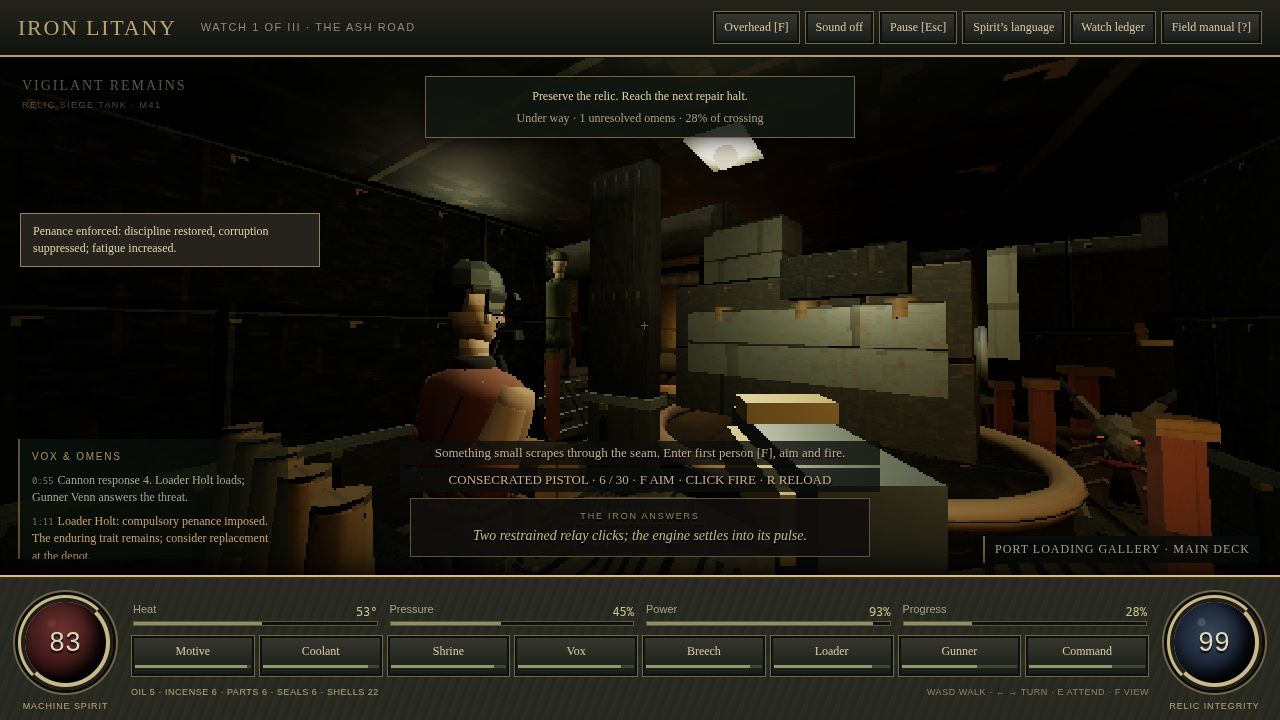
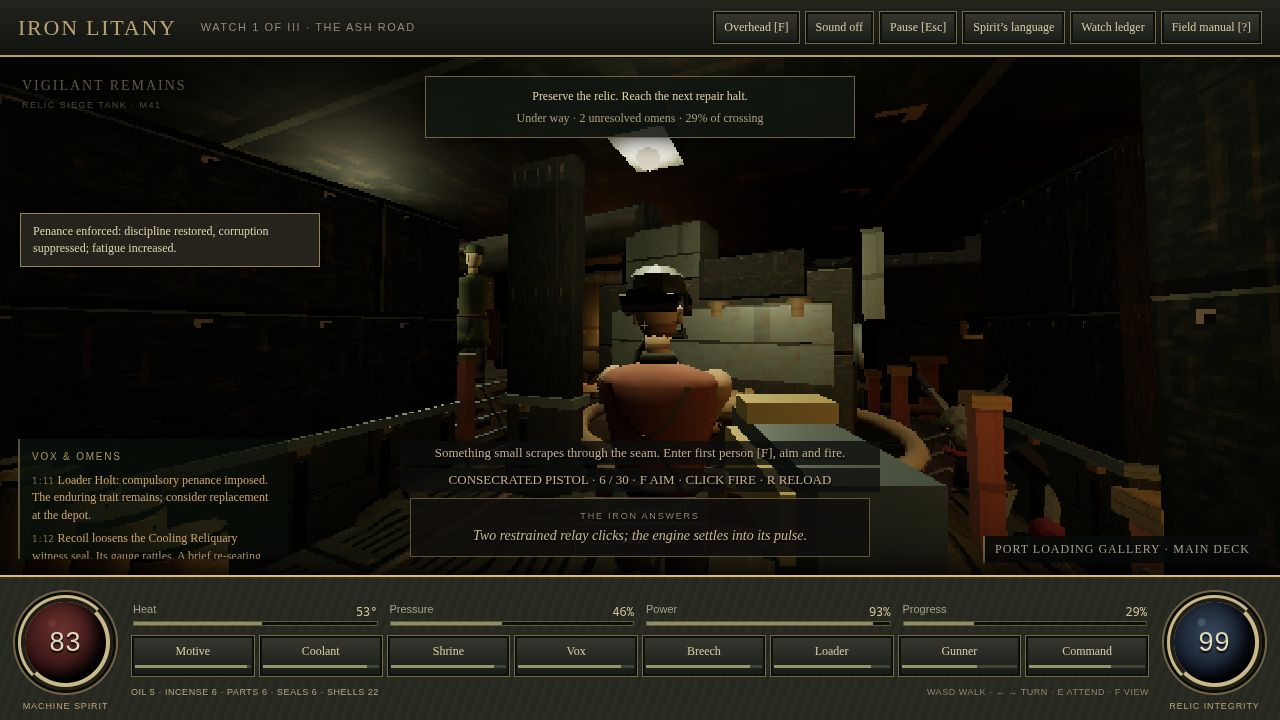
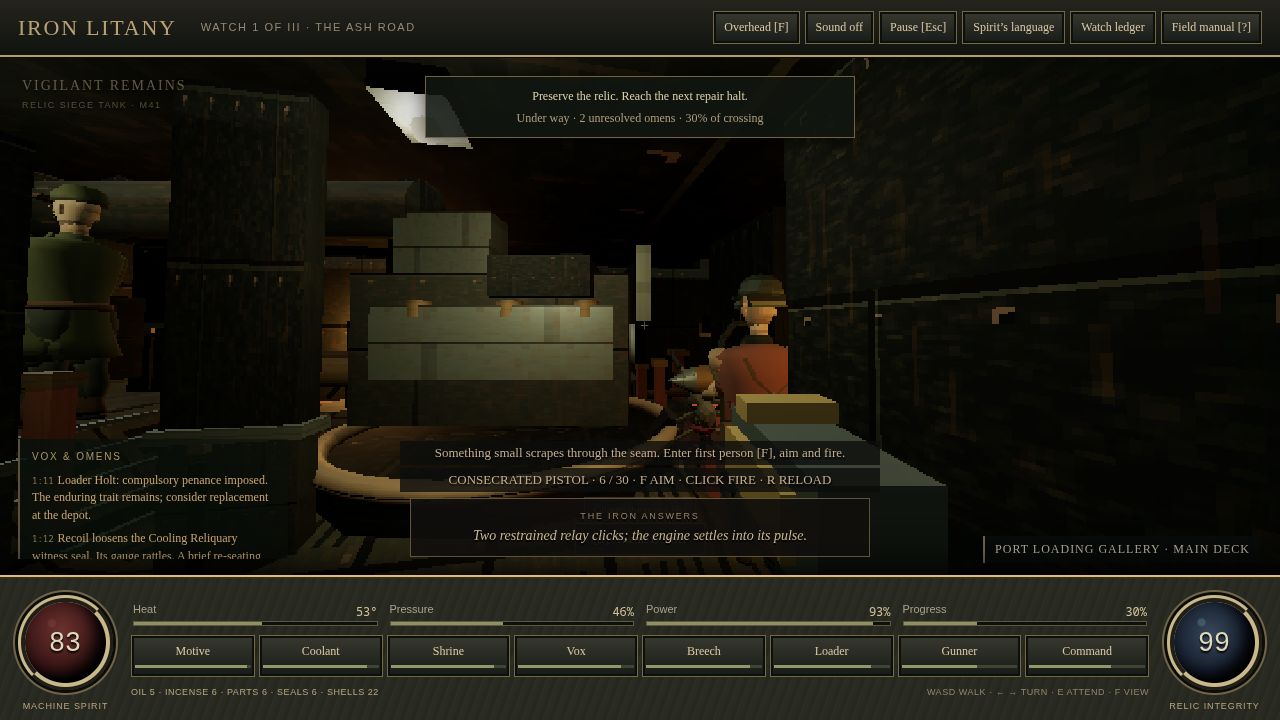
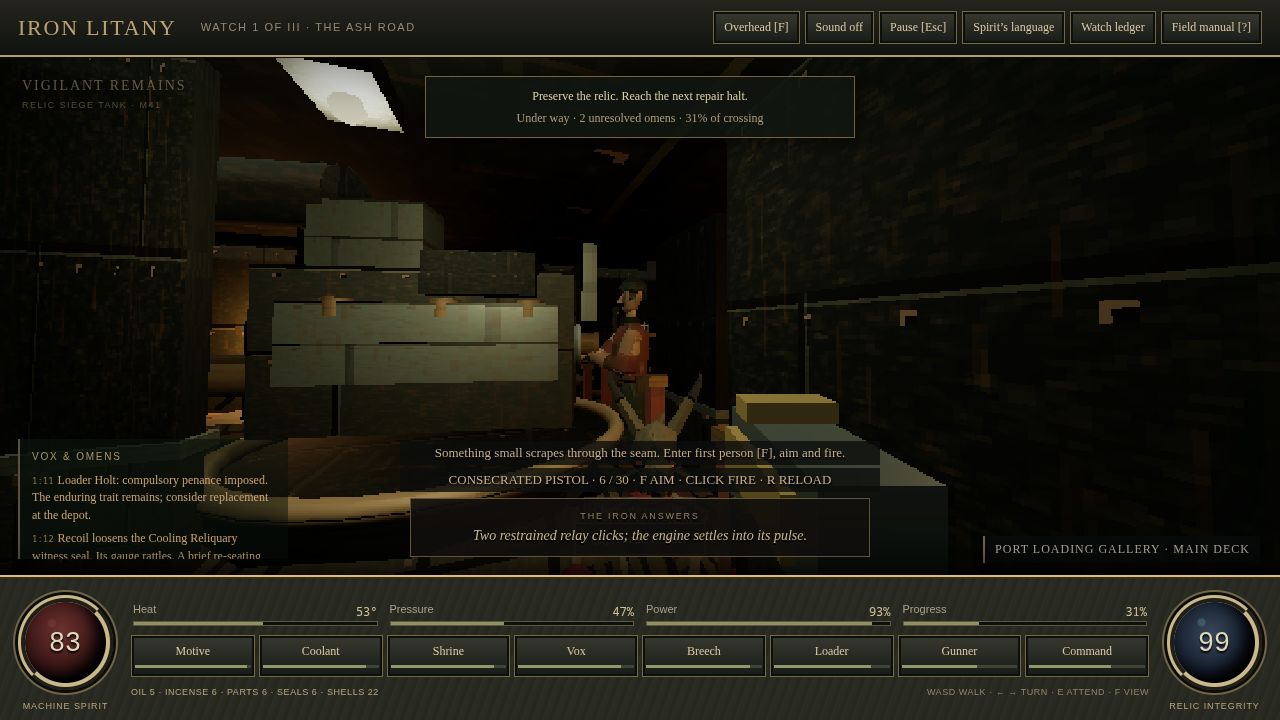
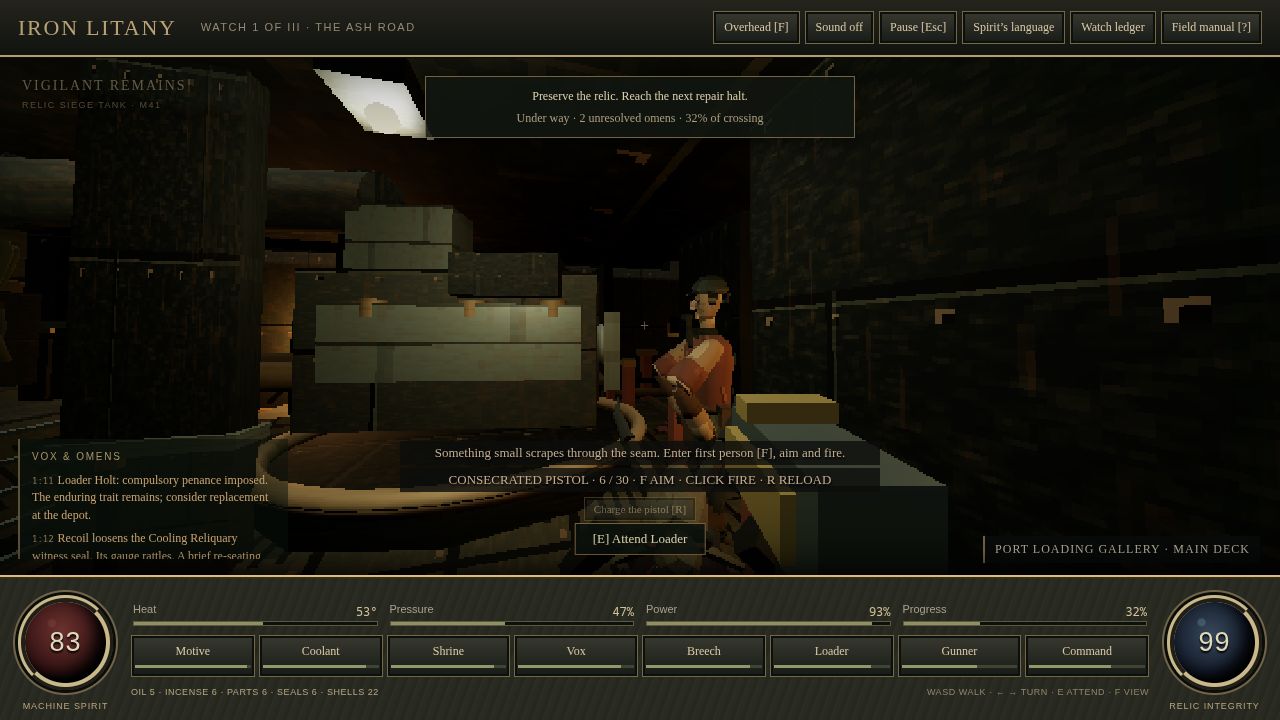
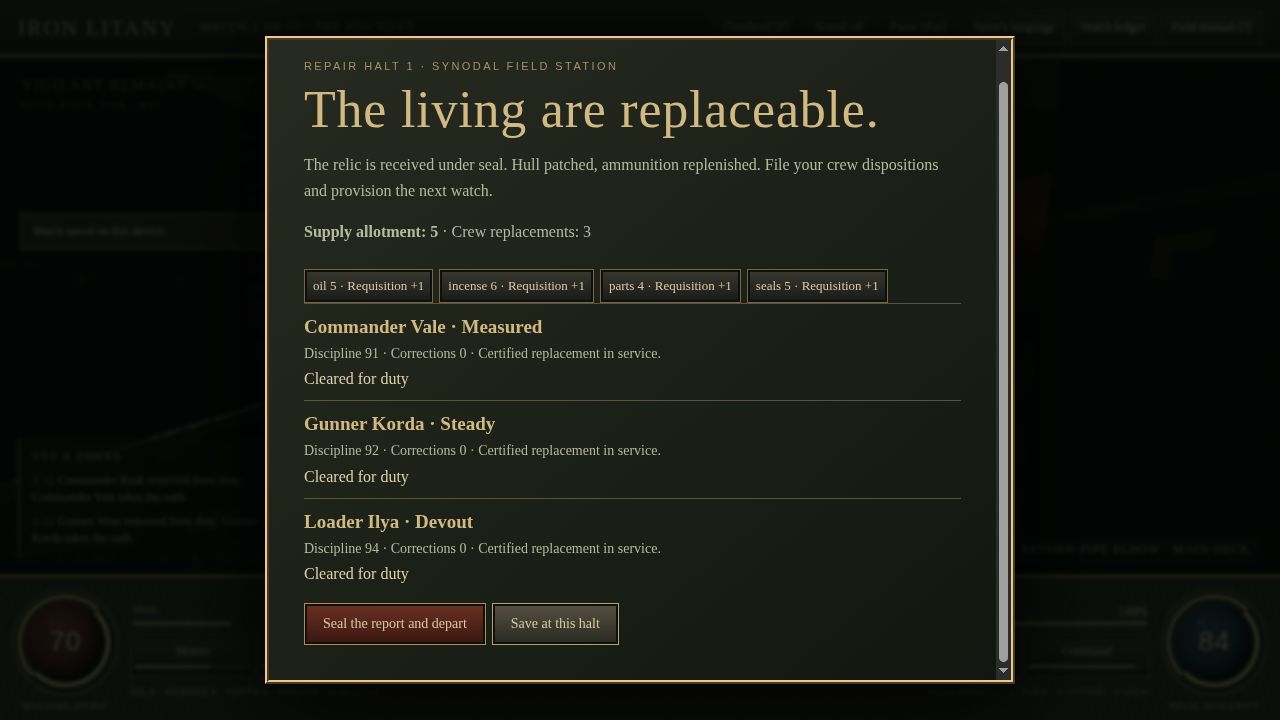
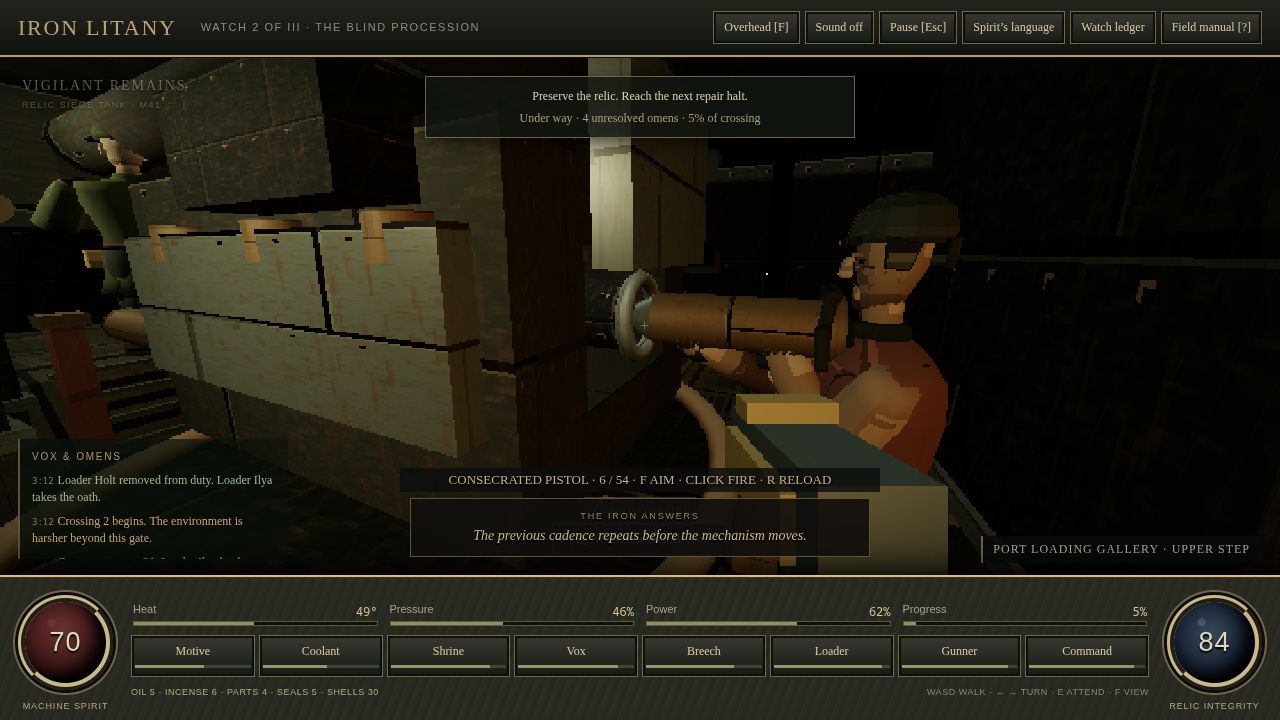
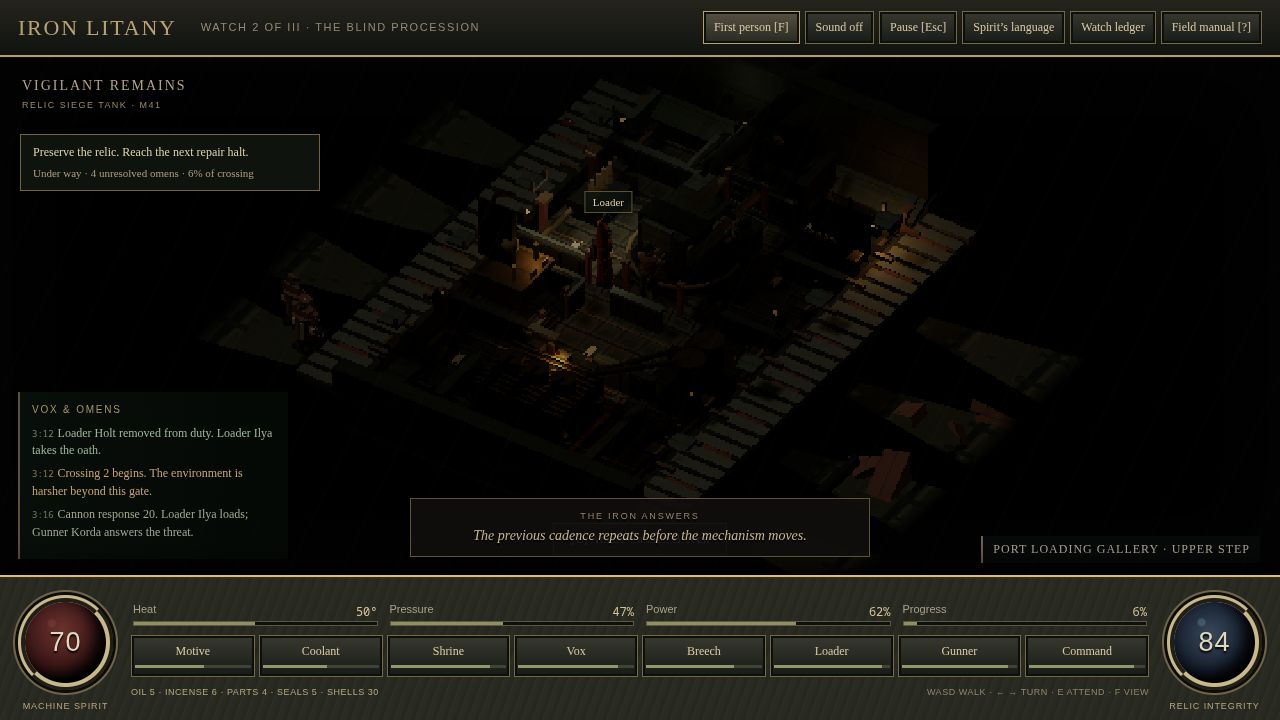
A prior resumed v0.3.0 local test was left running during baseline inspection and reached ward loss; it is not a defeat produced by the new candidate. No full three-watch victory is claimed for v0.3.1. A bounded final browser console check found no captured errors or warnings. Sound stayed off during this art/contact run; listening approval is open.
Geometry and regression evidence
There are 126 passing tests, including two new contracts for operator contact after parent movement and rotation, and the complete traversed insertion/hand-release/gate ordering. Whole-cycle reach samples cover −0.55, 0 and +0.55 radians, beyond the ordinary cannon traverse amplitude, without stretching adult arm lengths. The existing route, save, slit GPU, material rites and finite-ammunition contracts remain required.
Original unbatched character triangles: commander 3,564; gunner 3,840; loader 4,122. Heights remain 1.740 / 1.761 / 1.761 metres. The priest's geometry is unchanged. The representative first-person runtime sample reports 501 scene meshes after batching, seven point lights, 223 visible draws and 60 reported FPS. View direction affects draws, and automation cadence is not a performance benchmark.
Art boundary and next exemplar
The binding art direction and actual Clans interior/HUD reference were used for normal-size review. No reference pixels or meshes ship. Procedural face facets, finger shapes, garment deformation and recoil bracing still need stronger authorship; unique recruit faces, injuries and fatigue are not implemented. The service priest also still gestures without a hand touching the real station tool. These remain visible priorities, rather than a reason to claim this candidate finished.
The next religious interaction exemplar should make the listening rod contact a chosen pipe, distinguish a true loaded-bearing cadence from a false echo by physical vibration, and make diagnosis consume time while another duty competes. That is a proposal, not shipped behavior. Cinematic and narrated gameplay remain gated on the creator's explicit demo approval.