Iron Litany — art direction and acceptance
Version 1 · 5 October 2026 · Binding production direction, not a claim of finished art.
Source authority
1. The current creator brief is authoritative: Diablo I governs image, atmosphere, motion, interface and sound; the tank is a serious, brutal, inhabited machine.
2. The current Golden Keep Art and Atmosphere Bible — Timed Walkthrough Edition is the recovered production guide: 282 pages, with a 49-page current guide before a 233-page archive. See REFERENCE_INVENTORY.md for verified local paths.
3. The original Golden Keep character bible establishes substantial miniature-like form, deliberate pixel clusters and serious adult anatomy. Its isolated-character palette examples do not override the newer whole-world guide.
4. Diablo I and Clans gameplay/HUD references establish the scene and interface family. StarCraft cockpit references may inform machinery and selective lighting. Torchlight is a negative comparator.
5. LORE_RESEARCH.md governs setting evidence and identifies invented campaign rules. It does not authorize copying published artwork.
The source inventory records what was actually inspected. Original screenshots and bible pages are reference evidence, not distributable textures, sprites, logos, film or sound.
Current state
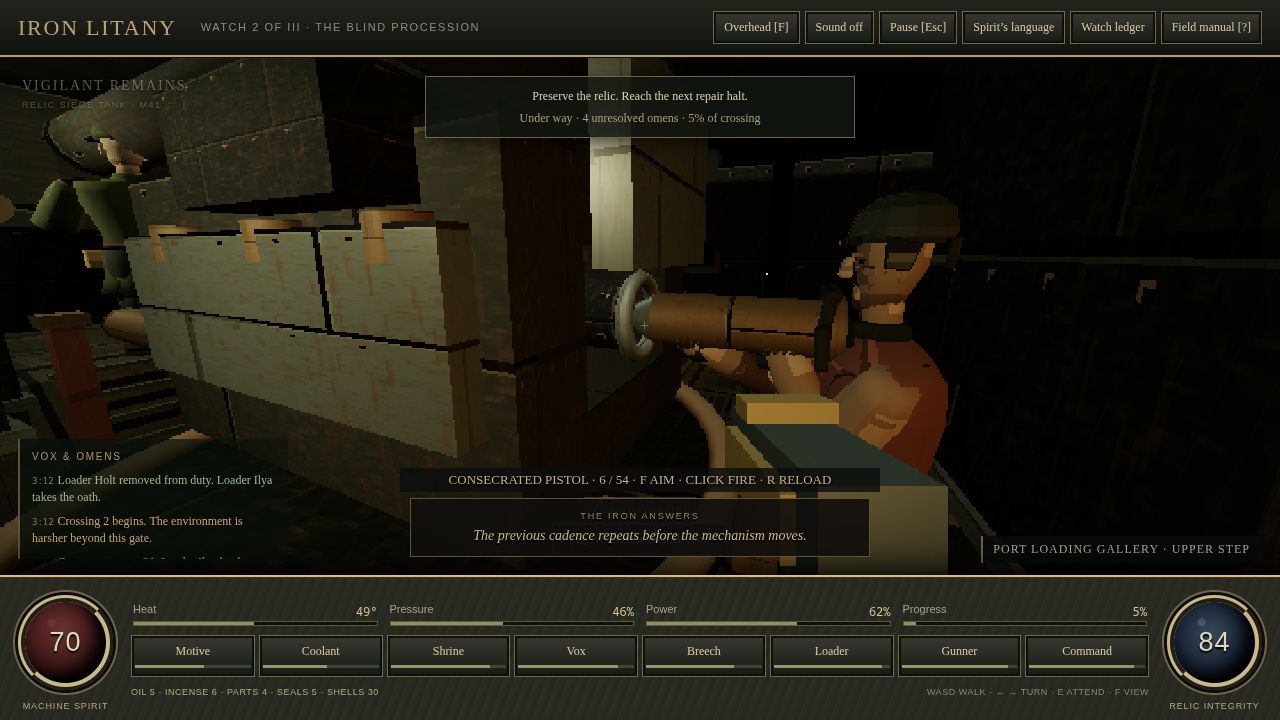
The v0.3.1 crew/contact candidate is recorded in CREW_AND_CONTACT_V031.md. Actual driving and traverse grips now anchor fixed-length operator arms. The cannon has a receiver cavity and a pointed, collared round; loading grips move with insertion and release before gate closure. Local task lamps expose the work without changing global grading or sampling. The open-mouth frame shows the final actual first-person result. Faces, fingers, garments and creature anatomy remain procedural candidates; this pass has not passed final art approval.
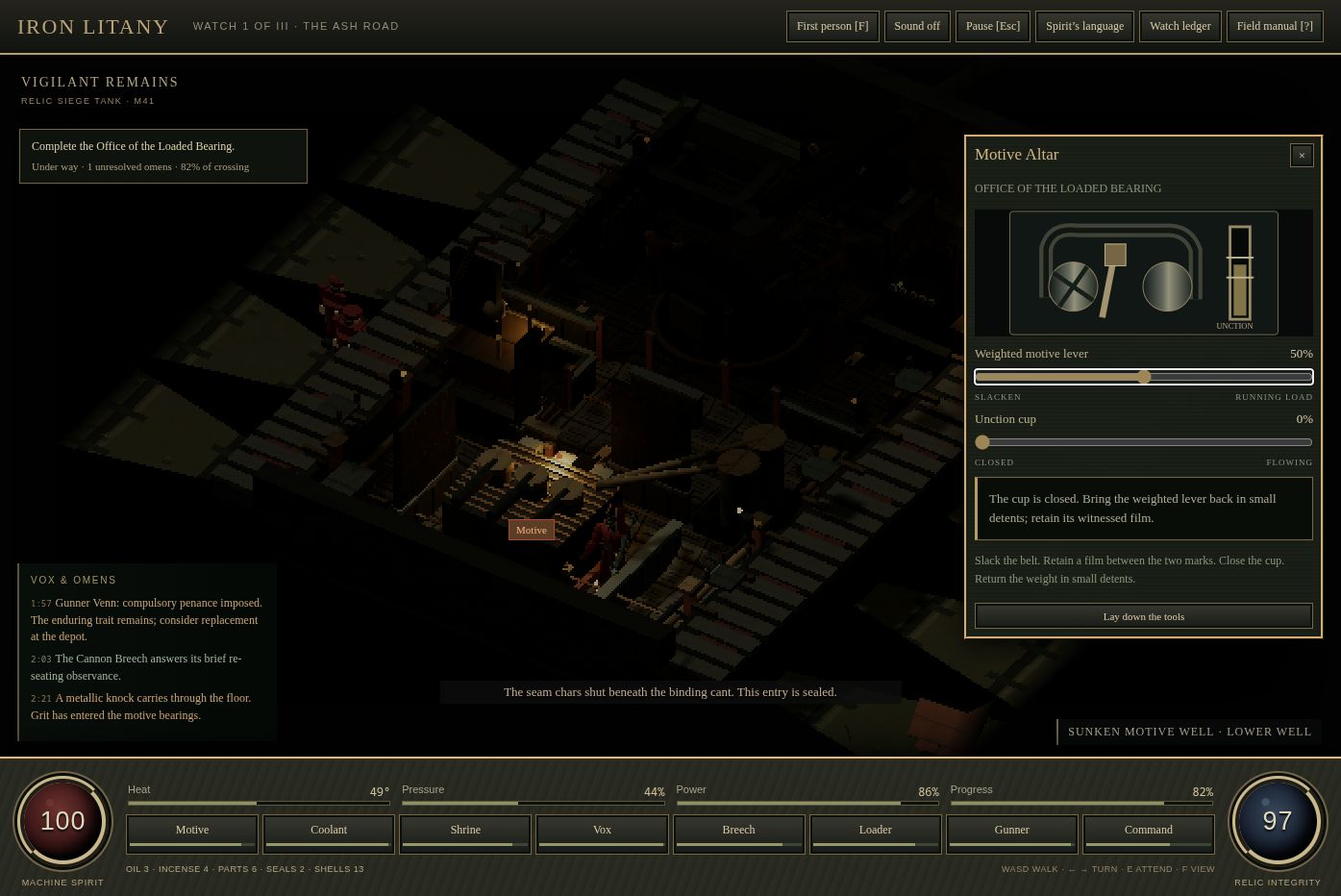
The v0.3.0 visual candidate adds sloped armour, cramped ribbed passages, local deck steps, current-hall lighting, a sunken engine and directly masked outdoor cones. The final bearing view shows the ordinary overhead result at its actual low-resolution footprint. The first unfolding experiment looked like floating cards during play and was retired from runtime. The outdoor scene now has nearer partial ruins, troops, armour and track-rutted ground, still bounded by black gaps.
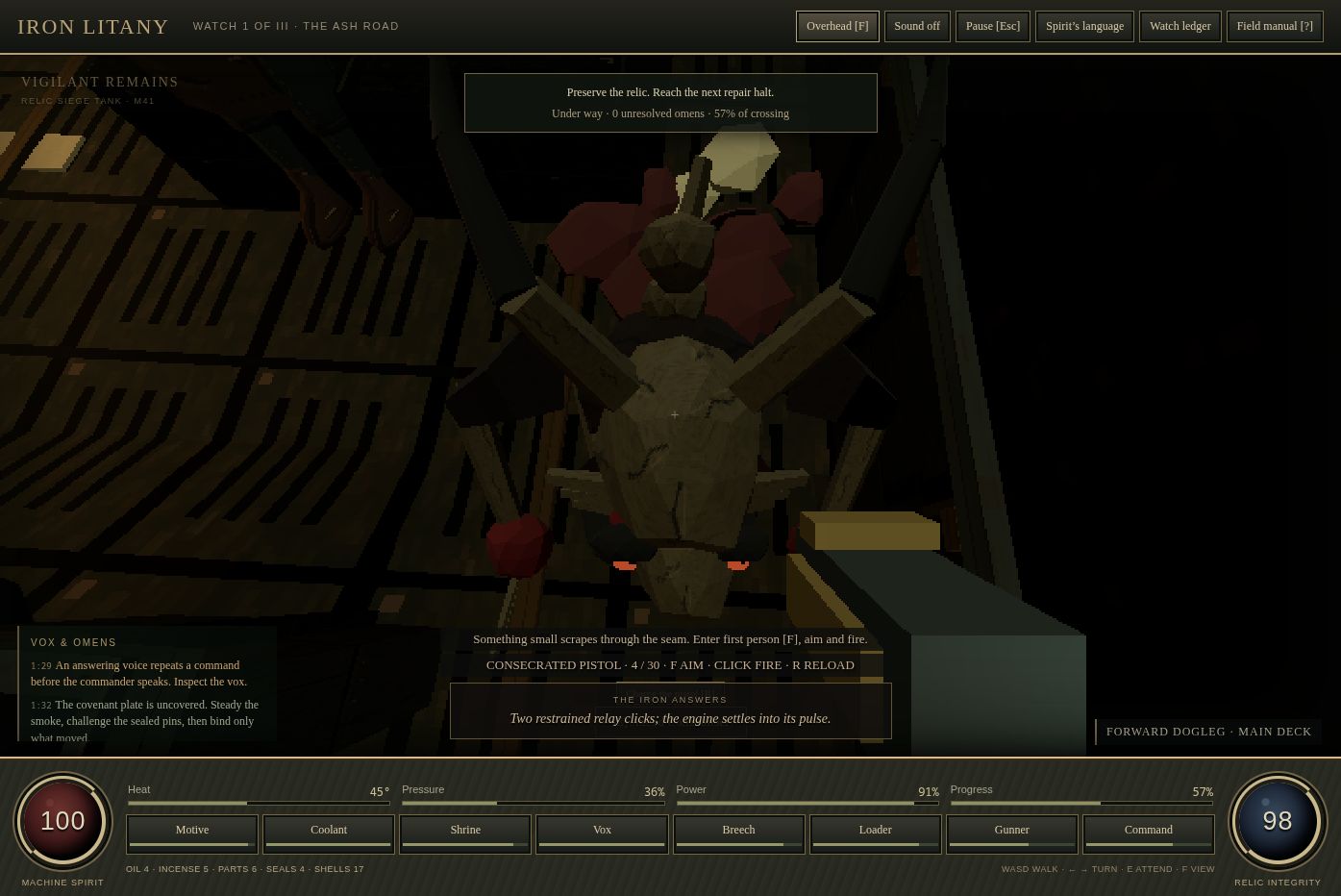
Original small/large intrusion forms were narrowed after first-person inspection, then given scarred-bone and torn-flesh material candidates. The current intruder close-up exposes the remaining procedural anatomy. It is not approved authored Diablo I creature art. Crew faces, hands, cloth weight and real shell/tool contact remain the next exemplar priority; new rooms do not close that gate. The new material cues and pistol sound also require human listening review.
The runtime is a procedural visual foundation: assembled geometry, generated surface textures, simple crew motion, a cutaway hull and two cameras. It demonstrates spatial systems and presentation constraints.
It is not the approved Diablo I art target. Promotional key art is concept/presentation art; it does not demonstrate the appearance or animation quality of gameplay.
Current rendering uses a deliberately small framebuffer, capped around 720 × 360 subject to aspect ratio. Nearest sampling alone cannot supply authored form, materials, contact or atmosphere.
First production exemplar, candidate status
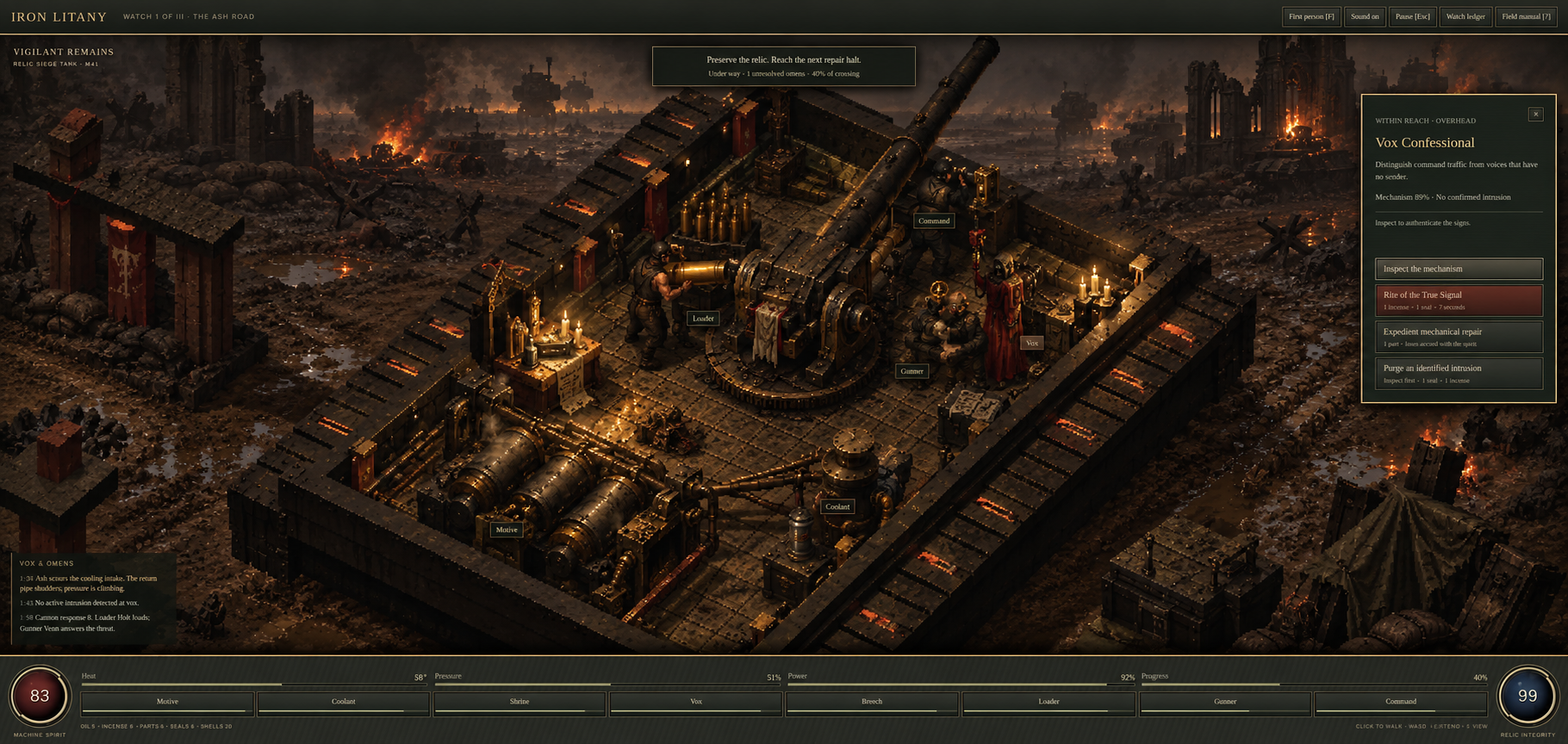
A new overhead direction plate is saved with its exact prompt and asset manifest. It is an AI-generated study derived from the actual foundation screenshot, and does not demonstrate runtime quality.
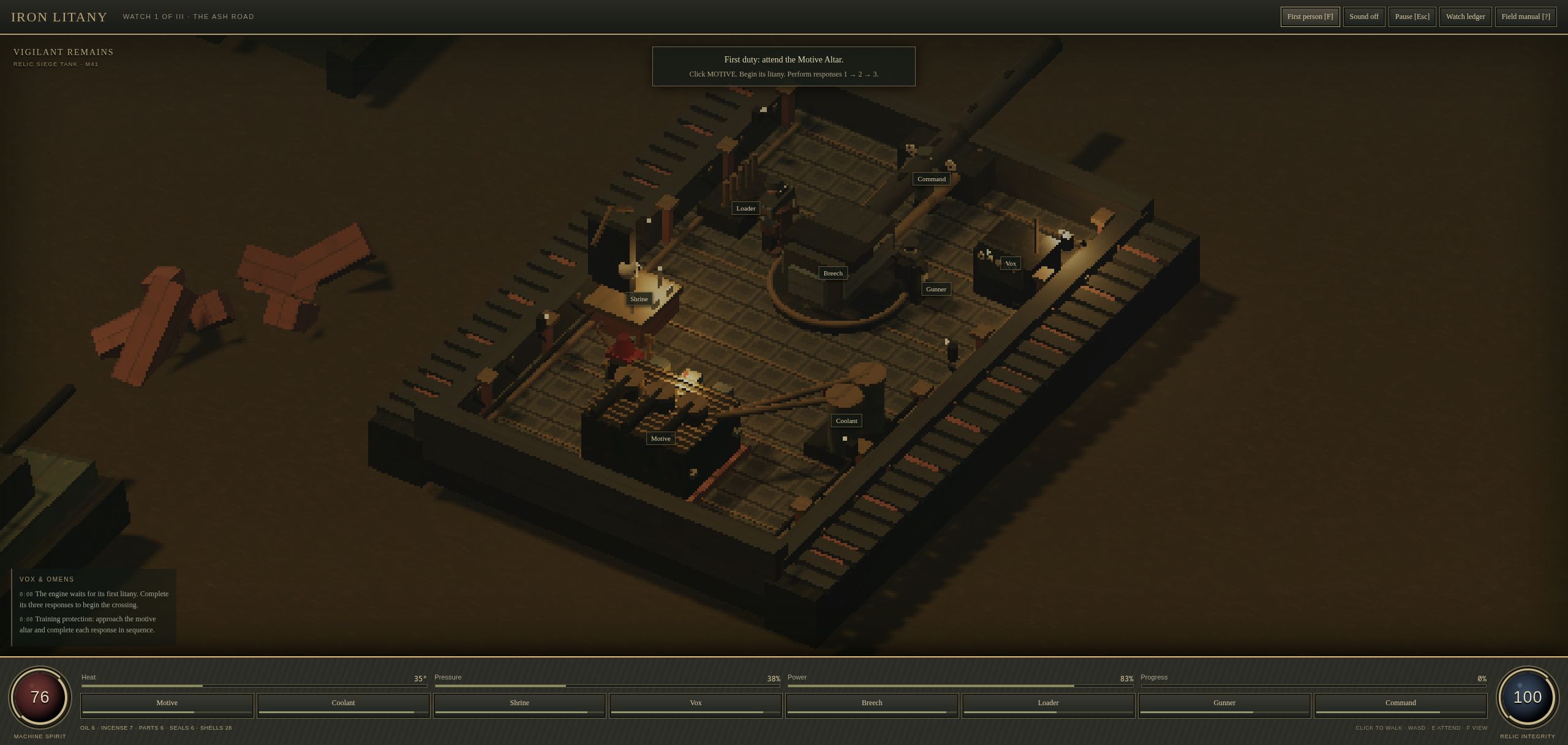
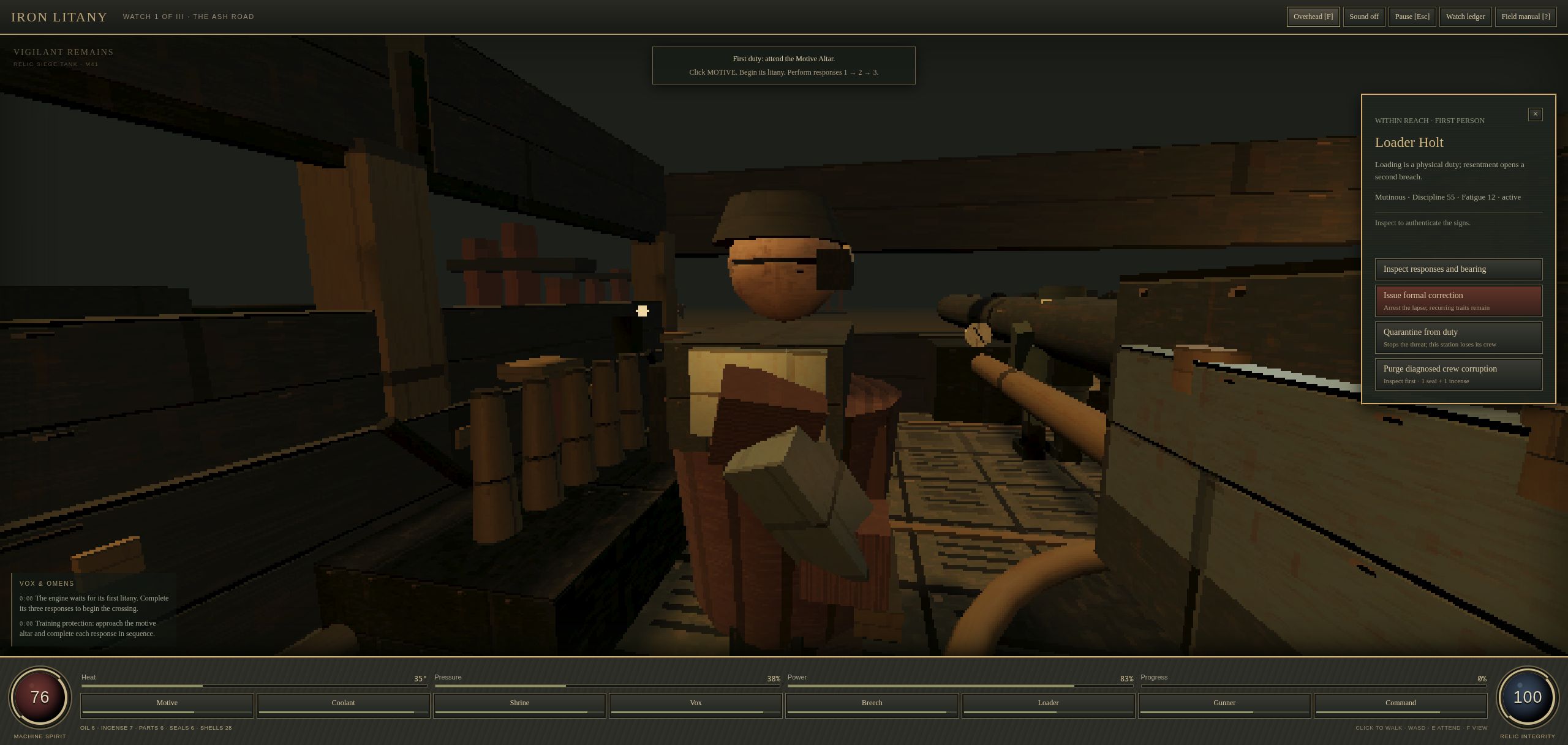
The implemented priest now has layered cloth, a cowl, service pack and mechanical arm. The loader has a separate work silhouette and arm rig; the engine service face and breech have additional parts. A shot event now drives an ordered shell-handling cycle. The camera is closer and the crew standing points avoid first-person overlap. These are candidate forms. The first-person screenshot shows clear access but still exposes simplified faces, hands and surfaces, so the exemplar has not passed art or motion approval.
Evidence: overhead runtime and loader close view. These paths are committed local records; the hosted art dossier carries the direction plate.
Loader motion revision, still a candidate
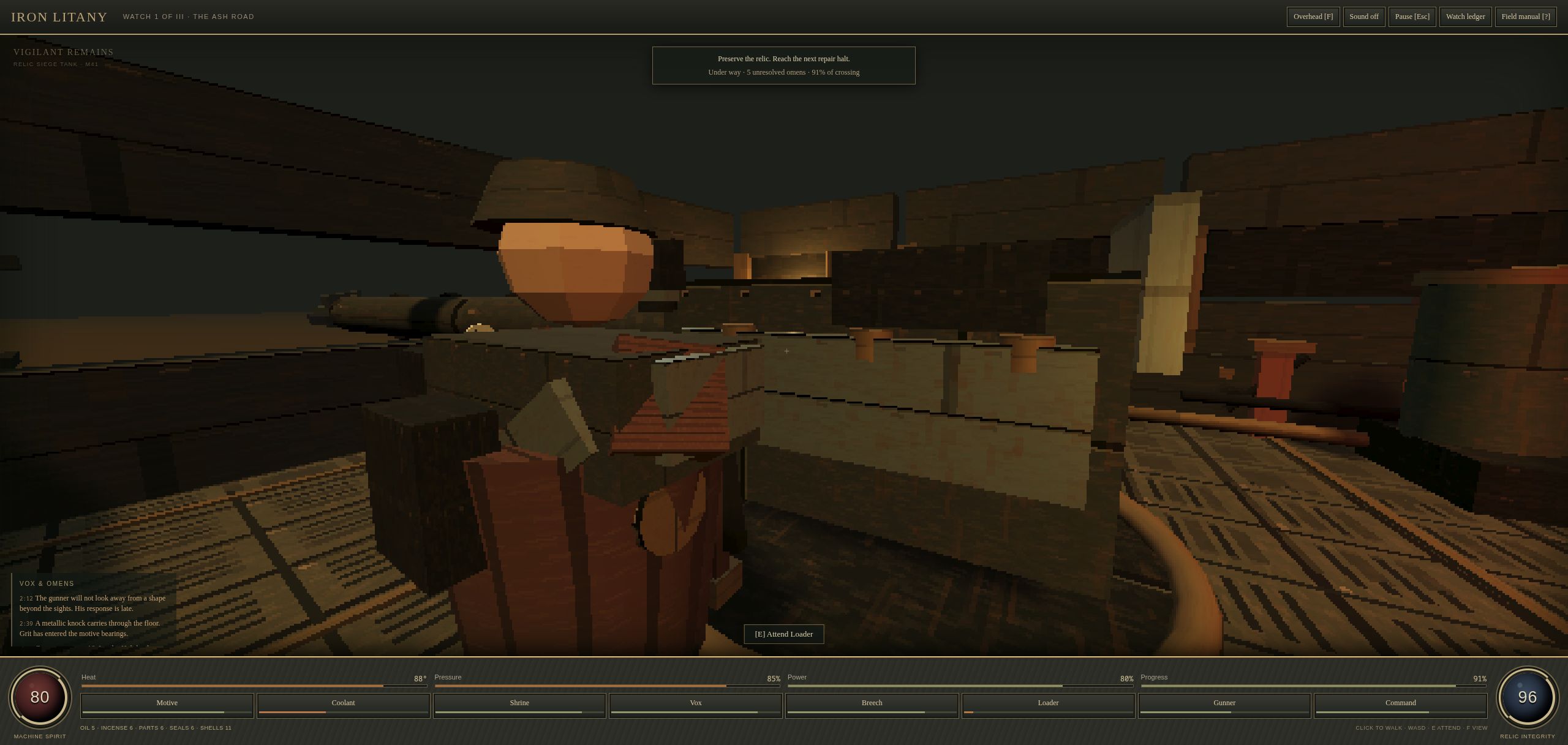
A live first-person review exposed an overextended arm as the shell approached the breech. The loader now steps between rack, carry and seating positions with the shell. A focused reach check keeps both target hand positions within 1.25 metres of their shoulders through the visible transfer; recoil preparation and recovery return him to his original post. The loader's interaction point has moved to the side aisle, and selecting him in first person turns toward both worker and breech.
Actual first-person transfer frame was captured in Watch 1 during the align stage. The view now includes the worker and gun assembly together, but the shell and grip are still partially hidden by the loader and cradle; his face, clothing and hands remain block-built. This is a documented improvement in reach and framing, not approved physical contact or Diablo I-quality art. The next art pass must make the shell's weight, both gripping hands and the insertion mouth legible in motion from this view and overhead. See loader motion manifest for provenance and review state.
Nonnegotiable visual rules
- Establish mass, thickness, cavities, joints and overlap before detail. A tank wall has depth; a shell has weight; a hand grasps a tool.
- Use serious adult proportions and differentiated silhouettes. Reject cute heads, rounded interchangeable bodies and caricatured cartoon expressions.
- Construct machinery from legible assemblies: cradle, ring, conduit, guard, fastener, valve, gauge, bearing and service access. Dirt cannot disguise missing construction.
- Separate structural form, assembly detail and surface wear. Leave quiet areas so meaningful details remain readable.
- Cloth folds, oily steel, rough iron, old bronze, glass, wax and parchment need distinct responses. Selective early-CGI metallic shine is appropriate; uniform waxy or plastic shading is not.
- Place wear where heat, friction, handling, impact and leakage cause it. Reject indiscriminate noise and identical rust over every material.
- Build connected shadows around bounded pockets of useful light. Keep the walking route, working hands, instrument and immediate threat readable.
- Use soot, iron, steel, old bronze, blood red, dirty bone and olive, with practical amber and controlled warning red. Reserve accents for role and state.
- Reject broad teal/orange grading, candy saturation, glowing outlines and blanket bloom. Darkness must not conceal unfinished geometry or essential controls.
- Establish the asset's actual gameplay footprint before reduction. Preserve deliberate clusters and hard sampling; reject a soft painting merely pixelated at the end.
- Do not impose an arbitrary global 24/32/64-color limit when it destroys material or role identity. Choose restrained ramps for a purpose.
- Treat the HUD as one crafted artifact: recessed panels, credible thickness, hierarchy and restrained ornament. Text, cursor, focus and critical symbols remain crisp.
- Animate anticipation, contact, applied force and recovery. The loader handles and seats the shell; the gunner operates the mechanism; the commander braces and drives.
- Grit and horror remain intentional. Gruesome detail supports the setting and stakes; it must not obscure the primary task or become a cheerful particle reward.
Asset contract and pipeline
Every asset ticket supplies role, physical dimensions, gameplay footprint, overhead and first-person distances, references, material breakdown and the action it must communicate.
Each asset manifest entry records id, version, kind, sourceFiles, runtimeFiles, dimensions, pivot, materials, palette, cameraFootprints, animations, collision, provenance, prompt, reviewStatus, approvedEvidence and byteSize.
Provenance separates creator material, reusable project code, licensed libraries, generated work and reference-only images. Keep exact prompts and source references for generated assets.
Use review states foundation, candidate, approved-still, approved-motion, approved-integrated, rejected. A still cannot grant motion approval.
1. Author one small representative sector: priest, loader, breech/engine material, hull/slit and working light.
2. Review clean form and contact poses before texturing. Reject wrong proportions or floating hands immediately.
3. Review the material set together under the intended light, then reduce to the intended footprint.
4. Integrate that sector into the actual game and capture overhead plus first-person evidence at normal displayed size.
5. Review normal action and crisis motion; check that gun recoil, hands, shell and mechanical response share one event sequence.
6. Approve the integrated exemplar before expanding across the tank. Keep it beside each subsequent asset during review.
Camera, lighting, tone mapping, material, palette or sampling changes reopen integrated review. Never silently replace the approved target with an easier one.
Required inspection gates
| Gate | Required evidence | Reject when |
| Overhead | Actual runtime still at normal size; labeled route, role silhouettes and station work | Crew blend into machinery; the route disappears; important materials read alike |
| First person | Actual approach, instrument use, slit view and turn away at the same body position | Enlarged primitives, flat texture planes, hollow hull edges or unreadable gauges dominate |
| Motion | Short bounded real-time sequence of walking, loading, aiming, firing and recovery | Shell floats, hands miss contact, recoil precedes closure, limbs orbit decoratively |
| Crisis | Real fault plus one competing task, with readable cues and controls | Flash/shake obscures action; all systems emit identical warnings |
| Continuity | Adjacent apertures and overhead show the same passing outside piece | Timing, direction, scale or identity disagree between views |
| Sound | Sustained sound-on play with captions, mute and gain checks | Repetition tires the listener, cues mask one another, or generated ambience is treated as approved by metrics alone |
Record build/commit, scene, camera, framebuffer/display dimensions, settings and evidence paths. Approval names the demonstrated state and remaining limitations.
Storage and release boundaries
Before any anticipated write above 1 GB, check actual available bytes on system and destination filesystems, resolving symlinks/mounts; retain at least 100 GB after peak temporary plus final storage. Target 150–200 GB ongoing headroom.
Use bounded captures and reuse verified assets. Do not restore archived environments or duplicate large builds to make an art ticket convenient.
The user's explicit gate remains: the demo must be done and approved before cinematic or narrated gameplay production begins. Cover/cassette art and a truthful foundation page do not satisfy that gate.